Social Security COLA 2027: 3.6% Raise and What It Means
Key Points – Social Security COLA 2027: 3.6% Raise and What It Means
- Social Security benefits increase 3.6% for 2027, announced by SSA on October 14, 2026.
- The average retirement benefit rises by about $75 a month beginning with January 2027 payments.
- SSI payments increase starting December 31, 2026.
- Medicare Part B premiums, IRMAA surcharges, and taxes can reduce how much of the raise you actually keep.
- COLAs apply to your benefit from age 62, even if you have not started collecting yet.
- 6-Minute Read
Social Security Administration Announces 3.6% COLA Increase for 2027
The Social Security Administration announced on October 14, 2026, that Social Security benefits will rise 3.6% in 2027.1 For the average retiree, that is about $75 more a month starting in January, and Supplemental Security Income (SSI) payments rise starting December 31, 2026. It is the largest cost-of-living adjustment since 2023.2
The increase reaches nearly 72 million Social Security beneficiaries and about 7.3 million people who receive SSI.1 Like every COLA, it is based on the Consumer Price Index for Urban Wage Earners and Clerical Workers (CPI-W), which measures how much prices rose over the past year.
When Does the 2027 Social Security COLA Take Effect?
The 3.6% increase applies to Social Security benefits payable in January 2027. SSI recipients see their higher payment first on December 31, 2026.
Here is when you will see your new amount:
- Late November 2026: COLA notices appear in the Message Center of your my Social Security account. Create an account by November 18 to view yours online.
- December 2026: SSA mails notices to beneficiaries who have not opted into paperless notices.
- December 31, 2026: SSI payments increase.
- January 2027: Social Security payments increase on your usual payment date.
COLA notices are also a familiar hook for fraud. SSA will not call, text, or email asking for personal information to “activate” your raise.
How Much Will Your Social Security Check Increase in 2027?
According to SSA, the average retirement benefit will increase by about $75 a month in January 2027.1 Your own increase depends on your current benefit. The table below shows a 3.6% raise at five common benefit levels.
| Current monthly benefit | Increase at 3.6% | New monthly benefit (before Medicare deductions) |
| $1,500 | +$54 | $1,554 |
| $2,000 | +$72 | $2,072 |
| $2,500 | +$90 | $2,590 |
| $3,000 | +$108 | $3,108 |
| $4,000 | +$144 | $4,144 |
Illustrative only. SSA rounds monthly payments down to the whole dollar, so your actual amount may differ slightly. Amounts are before Medicare premiums or tax withholding.
The maximum monthly benefit for a worker retiring at full retirement age rises to $4,188 in 2027, up from $4,152 in 2026.3
How the COLA Is Calculated
SSA calculates the COLA by comparing the average CPI-W for July, August, and September of the current year with the same three months of the prior year. For 2027, SSA compared the third-quarter 2026 average with the third-quarter 2025 average. The percentage increase, rounded to the nearest tenth, became the 3.6% COLA.3
Because the formula depends on September inflation data, the COLA is announced each October, shortly after the Bureau of Labor Statistics releases the September CPI. If prices do not rise, there is no COLA, and benefits do not decrease.
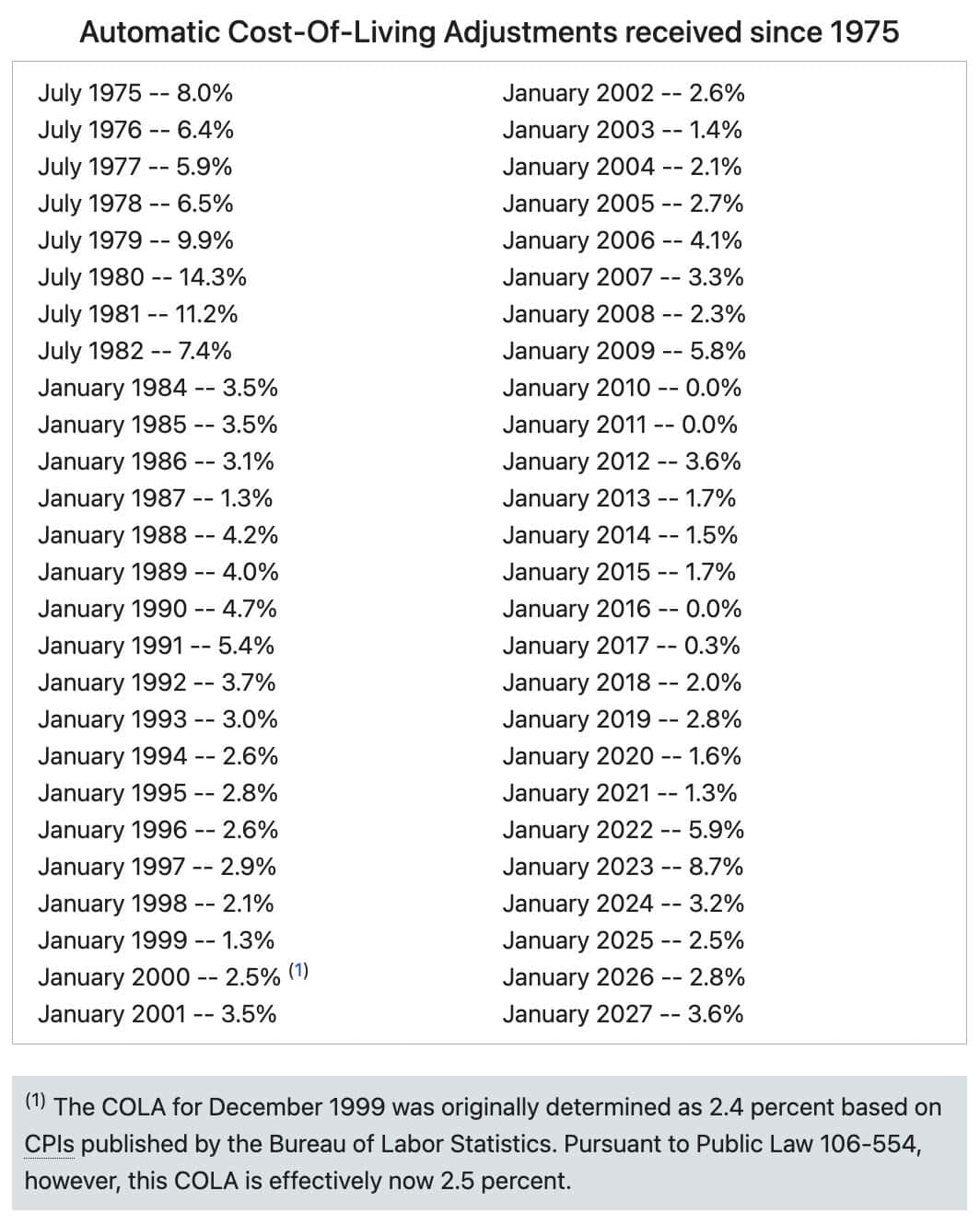
How 3.6% Compares: COLA History
At 3.6%, the 2027 COLA is the largest since the 8.7% increase for 2023 and above the 3.1% average of the prior 10 years.2 However, it’s important to view cost-of-living adjustments as a boost to keep up with inflation rather than as an increase.
Who Gets the COLA?
Everyone receiving Social Security or SSI gets the 3.6% increase automatically. There is nothing to apply for. That includes:
- Retired workers
- Spouses and divorced spouses receiving spousal benefits
- Surviving spouses and other survivors
- People receiving Social Security Disability Insurance (SSDI)
- SSI recipients
You do not have to be collecting to benefit. COLAs apply to your benefit starting at age 62, whether or not you have claimed. If you are waiting until full retirement age or 70, this year’s 3.6% is already built into the benefit you will eventually receive. Delaying does not forfeit the raise.
If you worked in a job not covered by Social Security, such as some public-sector roles, the repeal of the Windfall Elimination Provision and Government Pension Offset may have changed your benefit.
Federal retirees: CSRS and FERS
Civil Service Retirement System (CSRS) annuities generally receive the full 3.6% COLA in 2027.4 Federal Employees Retirement System (FERS) annuities use a reduced formula when the COLA exceeds 3%, which points to a 2.6% adjustment for 2027.4
The COLA You Actually Keep
A 3.6% raise is the gross number. What reaches your bank account depends on three things: your Medicare Part B premium, whether you’re subject to an income-related monthly adjustment amount (IRMAA), and how much of your benefit is taxed.
Medicare Part B
Most retirees have their Part B premium deducted directly from their Social Security check. The 2026 standard Part B premium is $202.90 a month. The 2026 Medicare Trustees Report projected a 2027 standard premium of $209.50, an increase of $6.60.5 CMS announces the official figure in November. If that projection holds, the average retiree’s net raise would look like this:
| Monthly amount | |
| Average COLA increase (SSA) | +$75 |
| Projected Part B premium increase | −$6.60 |
| Projected net increase | about +$68 |
Projection based on the 2026 Medicare Trustees Report.
The hold harmless provision protects most beneficiaries from a net decrease: if the dollar increase in the Part B premium is larger than your dollar COLA, your premium is limited so your check does not shrink.6 It does not apply to people who pay IRMAA, new Medicare enrollees, or those whose premium is not deducted from their benefit. With a $75 average raise against a projected $6.60 premium increase, few retirees should need it in 2027.
The Medicare Annual Enrollment Period runs October 15 to December 7. Make sure to review your coverage alongside your new benefit if you’re on Medicare.
IRMAA
Higher earners pay an IRMAA surcharge on top of the standard Part B and Part D premiums. IRMAA uses a two-year lookback, which means:
- Your 2027 Medicare premiums are based on your 2025
- The 2027 COLA can raise your 2027 modified adjusted gross income (MAGI) only through the taxable portion of your benefits.
- That 2027 MAGI sets your 2029
If your income sits close to an IRMAA threshold, a higher Social Security benefit is one more factor that could push you over.
Taxes on Benefits
Up to 85% of your Social Security benefit can be subject to federal income tax, depending on your provisional income. Those thresholds are not indexed to inflation and have not changed in decades.7
| Filing status | Up to 50% taxable above | Up to 85% taxable above |
| Single | $25,000 | $34,000 |
| Married filing jointly | $32,000 | $44,000 |
Because benefits rise each year and these thresholds do not, every COLA can push a little more of your benefit into taxable income.
Other Social Security Changes for 2027
The COLA is not the only figure that changes each January. Here is what else is new for 2027.3
| Item | 2026 | 2027 |
| Maximum taxable earnings | $184,500 | $192,300 |
| Earnings test, under full retirement age | $24,480/yr ($1 withheld per $2 over) | $25,560/yr |
| Earnings test, year you reach full retirement age | $65,160/yr ($1 withheld per $3 over) | $67,920/yr |
| Quarter of coverage | $1,890 | $1,970 |
| Maximum benefit at full retirement age | $4,152/mo | $4,188/mo |
| Substantial gainful activity (non-blind) | $1,690/mo | $1,770/mo |
If you are still working and earn above $184,500, the higher taxable maximum means more of your 2027 wages are subject to the 6.2% Social Security payroll tax.
What the 2027 COLA Means for Your Retirement Plan
The 2027 Social Security COLA serves as a prompt to revisit your plan. Here are three questions to address:
- Are you within a few thousand dollars of an IRMAA threshold? A higher benefit, a Roth conversion, or a large withdrawal could push 2027 income into a higher bracket and raise your 2029 Medicare premiums.
- Will the higher benefit make more of it taxable? Because the provisional income thresholds never move, a raise can increase the share of your benefit subject to tax. That may change how much you withhold or which accounts you draw from.
- If you have not claimed yet, does a 3.6% raise change your timing math? The COLA is already credited to your future benefit, so it does not argue for claiming early. It is a good moment to rerun the numbers on when to start.
Frequently Asked Questions About Social Security COLA 2027
Q: What is the Social Security COLA for 2027?
The 2027 Social Security COLA is 3.6%, announced by SSA on October 14, 2026.
Q: When will I see the 2027 COLA in my check?
Social Security benefits increase with January 2027 payments. SSI payments increase starting December 31, 2026.
Q: How much will the average Social Security check go up in 2027?
According to SSA, the average retirement benefit will rise by about $75 a month.
Q: Do I get the COLA if I haven’t started Social Security yet?
Yes. COLAs apply to your benefit starting at age 62, whether or not you have claimed.
Q: Will Medicare premiums take part of my 2027 COLA?
Likely a small part. The 2026 Medicare Trustees Report projected the standard Part B premium rising $6.60 to $209.50 in 2027. CMS sets the official premium in November.
Q: When was the 2027 COLA announced?
SSA announced the 2027 COLA on October 14, 2026, following the release of the September Consumer Price Index.
Q: Does SSI increase in 2027?
Yes. SSI payments rise 3.6%, starting with the payment on December 31, 2026.
Do You Have Questions About the 2027 Social Security COLA as It Relates to Your Plan?
We hope this article about the 2027 Social Security COLA has helped you understand what it might mean for you. If you have questions about how the 2027 Social Security COLA fits into your plan, we’re here to help.
Security is an important component of a retirement income strategy for many retirees. But as our Head of Advisory Services Logan DeGraeve explained on an episode of Modern Money Moves with Managing Director Craig Houck, you can’t look at Social Security in a vacuum. The timing of retirement account withdrawals, taxes, and Medicare are other important components that need to be considered.
We want you to be confident, not only about how the 2027 Social Security COLA relates to your plan, but each aspect of your financial life. That’s why we’ve created the Modern Confidence Score. It’s designed to facilitate planning discussions involving taxes, investments, estate, and insurance, and how we go about building a comprehensive plan that’s tailored to your goals. Get your Modern Confidence Score today and we’ll be in touch with the next steps to determine how we may be able to help you enjoy today with confidence for tomorrow.
Get Your Modern Confidence Score
Resources Mentioned in This Article
[1] https://www.ssa.gov/blog/en/posts/2026-10-14.html
[3] https://www.ssa.gov/news/en/cola/factsheets/2027.html
[6] https://www.ssa.gov/blog/en/posts/2020-11-30.html
[7] https://www.irs.gov/publications/p915
Investment advisory services offered through Modern Wealth Management, LLC, a Registered Investment Adviser.
The views expressed represent the opinion of Modern Wealth Management, a Registered Investment Adviser. Information provided is for illustrative purposes only and does not constitute investment, tax, or legal advice. Modern Wealth Management does not accept any liability for the use of the information discussed. Consult with a qualified financial, legal, or tax professional prior to taking any action.
The Modern Confidence Score is an informational tool designed to help identify an individual’s self-reported level of confidence regarding certain areas of their financial life. It does not measure investment performance, financial security, or the likelihood of achieving financial goals.