Year-End Tax Planning for 2026
This article has been reviewed by Corey Hulstein, CPA.
Key Points – Year-End Tax Planning for 2026
- Year-end tax planning moves such as loss harvesting, RMDs, Roth conversions, and annual gifts, must be completed prior to December 31, 2026.
- Looking Back at the One Big Beautiful Bill Act Tax Provisions
- Reviewing 2026 Tax Brackets and Retirement Plan Contribution Limits
- A Year-End Tax Planning Checklist for 2026
- 8-Minute Read
An Important Deadline for Year-End Tax Planning Moves
Many of the year-end tax planning moves that shape your 2026 tax bill must be made before December 31. Once the calendar turns, the window closes on tax-loss harvesting, most retirement plan deferrals, Required Minimum Distributions, Roth conversions, charitable gifts, and annual exclusion gifts. That is why year-end tax planning is important to review in Q4 rather than in April.
Year-End Tax Planning Considerations: What’s New for 2026?
2026 is the first full tax year in which many One Big Beautiful Bill Act provisions apply. OBBBA was signed into law on July 4, 2025, and included the following provisions:
- Made the lower individual tax brackets permanent
- Raised the state and local tax (SALT) deduction cap
- Added new deductions for seniors, tips, and overtime
- Rewrote the rules for charitable giving
In this article, we will walk through some important 2026 numbers and the year-end tax planning strategies that may help you keep more of what you earn. Remember that every situation is different, so treat this as a starting point for a conversation with your tax and financial professionals rather than a recipe.
Know the 2026 Numbers Before You Act
Year-end tax planning starts with knowing where you stand. The IRS released its 2026 inflation adjustments in October 2025. Below are some of the figures that come up most often in planning conversations. Don’t confuse these with numbers with the 2027 inflation adjustments, which are typically released in late October/early November.1
| Item | 2026 Amount |
| Standard deduction, married filing jointly | $32,200 |
| Standard deduction, single | $16,100 |
| Standard deduction, head of household | $24,150 |
| 37% bracket begins, married filing jointly | $768,700 |
| 37% bracket begins, single | $640,600 |
| 0% long-term capital gains rate, married filing jointly | Taxable income up to $98,900 |
| 0% long-term capital gains rate, single | Taxable income up to $48,450 |
| SALT deduction cap | $40,400 (phases down above $505,000 of modified AGI, to no less than $10,000) |
| Additional deduction for age 65 and older | $6,000 per person (phases out above $75,000 single, $150,000 joint) |
| Annual gift tax exclusion | $19,000 per recipient |
| Estate and lifetime gift exemption | $15,000,000 per person |
Important Year-End Tax Planning Takeaways for 2026
Is It Worth Itemizing Again?
Let’s take a deeper dive into the higher SALT cap. It may make itemizing worthwhile again. From 2018 through 2024, the $10,000 cap pushed most households to the standard deduction. With the cap now at $40,400, homeowners in higher-tax states may find that state income tax, property tax, mortgage interest, and charitable gifts add up to more than the standard deduction. If you are close to the line, timing matters.
The $6,000 Bonus Senior Deduction
Taxpayers 65 and older can claim an extra $6,000 deduction through 2028, on top of the existing additional standard deduction. It phases out as modified AGI rises, so a large Roth conversion or capital gain late in the year could shrink or eliminate it.
A Consideration for High-Income Earners
Top earners face a new limit on itemized deductions. Beginning in 2026, the tax benefit of itemized deductions is capped at 35 cents per dollar for taxpayers in the 37% bracket. That makes it more valuable for some high earners to accelerate deductions into years when they are in a lower bracket.
OBBBA Deductions to Keep in Mind
Workers may deduct up to $25,000 of qualified tips and up to $12,500 of qualified overtime pay ($25,000 joint), and buyers of new U.S.-assembled vehicles may deduct up to $10,000 of loan interest. Each has income limits, so check eligibility before counting on them.
Make the Most of Retirement Accounts
Retirement contributions remain one of the most direct levers in year-end tax planning, and the 2026 limits moved higher across the board. Don’t confuse these with the 2027 limits, which are typically released in late October/early November.2
| Account | 2026 Limit |
| 401(k), 403(b), governmental 457 deferral | $24,500 |
| Catch-up, age 50 and older | $8,000 (total $32,500) |
| Catch-up, ages 60 through 63 | $11,250 (total $35,750) |
| IRA contribution | $7,500 |
| IRA catch-up, age 50 and older | $1,100 |
| SIMPLE IRA deferral | $17,000 |
| HSA, self-only / family coverage | $4,400 / $8,750 (plus $1,000 at 55 and older) |
Check Your Workplace Plan Now
Employee deferrals to a 401(k) or 403(b) generally must come out of paychecks dated by December 31. If you are behind, ask your payroll department to raise your deferral rate for the remaining pay periods. IRA and HSA contributions for 2026 can still be made until the April 15, 2027 filing deadline.
Along with checking your workplace plan now, take a couple of minutes to get your Modern Confidence Score. At Modern Wealth, our advisors are supported by specialists in tax, as well as investments, estate, and insurance to help build connected financial plans tailored to each client’s specific goals and circumstances. The Modern Confidence Score assesses your confidence across each of those areas. Get your Modern Confidence Score today, and our team will be in touch with next steps to help determine how to build your confidence in year-end tax planning and other aspects of your financial life.
Answer four quick questions to see your score. "*" indicates required fields Your resultHow confident is your tax plan?
There’s a New Roth Catch-up Rule
Starting in 2026, if you earned more than $150,000 in FICA wages from your employer in 2025, any catch-up contributions you make to that employer’s plan must go in as Roth (after-tax) dollars. You lose the current-year deduction on those catch-up dollars but build tax-free growth instead. Confirm that your plan offers a Roth option, since a plan without one may not allow high earners to make catch-up contributions at all.
Should You Consider a Roth Conversion in a Lower-Income Year?
Converting part of a traditional IRA to a Roth IRA adds the converted amount to this year’s taxable income in exchange for tax-free qualified withdrawals later. Now that the current brackets are permanent, the case for conversion rests less on a looming rate increase and more on your own income pattern. Years between retirement and the start of Social Security or required minimum distributions are often good candidates. A conversion must be completed by December 31 to count for 2026, and it cannot be undone.
Before converting, model the knock-on effects. Extra income can reduce the $6,000 senior deduction, push more Social Security benefits into taxable income, trigger the 3.8% net investment income tax, or raise Medicare premiums two years later through IRMAA surcharges. A partial conversion sized to “fill” your current bracket is often a more measured approach than converting everything at once.
Review Your Taxable Investment Accounts
Your brokerage account is where some of the most flexible year-end tax planning happens, because you control when gains and losses are realized.
Harvest Losses to Offset Gains
Selling an investment that has fallen below its cost basis lets you realize a capital loss. Losses first offset capital gains, and up to $3,000 of any excess can offset ordinary income, with the rest carried forward to future years. If you want to stay invested, you can buy a similar but not “substantially identical” holding. Avoid repurchasing the same security within 30 days before or after the sale, or the wash sale rule will disallow the loss. That rule also applies to purchases in your IRA or your spouse’s accounts.
Harvest Gains When Your Rate Is 0%
The opposite move can be just as valuable. If your 2026 taxable income falls below $98,900 (married filing jointly) or $48,450 (single), long-term gains up to that threshold may be taxed at 0%. Selling appreciated shares and buying them back resets your cost basis higher, and the wash sale rule does not apply to gains. Retirees with modest income, and families in a temporary low-income year, are common candidates.
To learn more about considerations for harvesting gains and losses and how a forward-looking tax plan can be an important component of a comprehensive financial plan, get a copy of our Retirement Plan Checklist. Along with timelines of retirement planning considerations, it includes a 30-question checklist of yes-or-no questions to help gauge your retirement readiness.
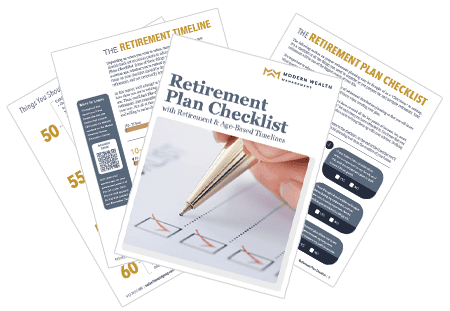
Download: Retirement Plan Checklist
Watch for Mutual Fund Distributions
Many funds pay capital gain distributions in November and December. Buying into a fund just before its record date may result in a tax bill on gains earned before you invested. Check estimated distribution dates before making new purchases in taxable accounts.
Don’t Miss Your RMDs
If you are 73 or older, your 2026 RMD from traditional IRAs and most workplace plans generally must be taken by December 31. Missing it can mean a 25% excise tax on the shortfall, reduced to 10% if corrected promptly. If you turned 73 this year, you may delay your first RMD until April 1, 2027, but you would then take two distributions in 2027. Beneficiaries of inherited IRAs subject to the 10-year rule may also owe annual distributions, so review those accounts as well.
Rethink Charitable Giving Under the New Rules
Charitable giving changed significantly for 2026, so it deserves a fresh look in your year-end tax planning.
A New Deduction for Non-Itemizers
If you take the standard deduction, you can now deduct up to $1,000 ($2,000 for married couples filing jointly) of cash gifts made directly to qualifying public charities. Gifts to donor-advised funds and most private foundations do not qualify, so write the check to the charity itself.
A 0.5% Floor for Itemizers
If you itemize, only the portion of your charitable giving that exceeds 0.5% of your AGI is deductible.3 With $300,000 of AGI, for example, the first $1,500 of gifts produces no deduction. Top-bracket taxpayers also face the 35% cap on the value of itemized deductions described above.
Bunching Charitable Donations in 2026
Because the floor applies every year, concentrating two or three years of planned giving into a single year can help you clear both the floor and the standard deduction. A donor-advised fund is a common tool here. You receive the deduction in the year you contribute, then recommend grants to your favorite charities over time.
Give Appreciated Assets Instead of Cash
Donating stock or fund shares held more than a year generally lets you deduct the fair market value while avoiding capital gains tax on the appreciation. Allow extra time, since transfers between custodians can take several business days to settle before December 31.
Qualified Charitable Distributions for Individuals 70½ and Older
A QCD lets you send up to $111,000 in 2026 directly from your IRA to charity.4 The distribution is excluded from your income and can count toward your RMD. Because it never enters your AGI, a QCD sidesteps the 0.5% floor and may help preserve the senior deduction and keep Medicare premiums lower. QCDs must come directly from the IRA custodian to the charity, and they cannot go to a donor-advised fund.
Gifting, Estate, Health Accounts, and Business Owners
Use Your Annual Exclusion Gifts
You can generally give up to $19,000 per recipient in 2026 without using any of your lifetime exemption or filing a federal gift tax return, provided the gifts qualify for the annual exclusion. A married couple can generally give a combined $38,000 to each child, grandchild, or other recipient, although gift-splitting arrangements may require filing a gift tax return.
The exclusion does not carry over, so unused amounts are lost on December 31. Contributions to a 529 education savings plan count toward the exclusion, and many states offer a state income tax deduction for them as well.
Revisit Your Estate Plan with the New Exemption in Mind
The OBBBA set the federal estate and lifetime gift exemption at $15 million per person for 2026, indexed for inflation in later years, instead of letting it fall by roughly half as previously scheduled. For many families, that removes federal estate tax as a concern. It does not remove the need for current wills, trusts, beneficiary designations, and powers of attorney, and some states still impose their own estate or inheritance taxes at much lower thresholds.
Business Owners May Have Extra Levers
The 20% qualified business income deduction for pass-through businesses is now permanent, and 100% bonus depreciation has been restored for qualifying property acquired after January 19, 2025.5 Placing equipment in service before December 31, timing invoices and expenses, and funding a SEP IRA or solo 401(k) may all reduce 2026 taxable income. Coordinate with your CPA, since accelerating deductions is not always the right answer if you expect higher income next year.
Your Year-End Tax Planning Checklist
Use this list to work through the deadlines that close on December 31, 2026.
ο Project your 2026 taxable income and bracket, including the senior deduction and SALT phase-down ranges
ο Compare itemizing against the standard deduction and decide whether to prepay property tax or state estimates
ο Increase 401(k) or 403(b) deferrals for remaining paychecks if you are behind your target
ο Confirm whether your catch-up contributions must be Roth under the new $150,000 wage rule
ο Evaluate a partial Roth conversion and model its effect on Medicare premiums and other deductions
ο Review taxable accounts for loss harvesting or 0% gain harvesting, and watch the wash sale rule
ο Take required minimum distributions from your own and inherited IRAs
ο Plan charitable gifts around the 0.5% floor, consider bunching, and use QCDs or appreciated stock where they fit
ο Make annual exclusion gifts and 529 contributions
ο Note the April 15, 2027 deadline for 2026 IRA and HSA contributions
Start the Year-End Tax Planning Conversation Early
The year-end tax planning strategies we’ve reviewed in this article often interact with each other. A Roth conversion can reduce your senior deduction, a bunched charitable gift can change whether you itemize, and a capital gain can affect your Medicare premiums two years from now.
At Modern Wealth, we believe that year-end tax planning should look at the whole picture rather than one move at a time. Your financial advisor and tax professional should be coordinating on year-end tax planning strategies well before the last week of December.
If you have questions about year-end tax planning for 2026 and want to learn more about Modern Wealth’s service offerings, including tax planning, start by getting your Modern Confidence Score today. Confidence is critical when it comes to the many complexities involved with year-end tax planning. Our goal with our connected planning services is to help you enjoy today, prepare for tomorrow, and connect with the people and causes you care about most. We look forward to meeting with you about next steps once you complete your Modern Confidence Score.
Get Your Modern Confidence Score
Resources Mentioned in This Article
[1] https://www.wolterskluwer.com/en/expert-insights/projected-2027-federal-tax-brackets
[2] https://401kspecialistmag.com/2027-401k-contribution-limits-all-but-official-25500-expected/
[4] https://www.congress.gov/crs-product/IF11377
[5] https://www.irs.gov/newsroom/qualified-business-income-deduction
Investment advisory services offered through Modern Wealth Management, LLC, a registered investment adviser.
The views expressed represent the opinion of Modern Wealth Management, LLC, a registered investment adviser. Information provided is for illustrative purposes only and does not constitute investment, tax, or legal advice. Modern Wealth Management does not accept any liability for the use of the information discussed. Consult with a qualified financial, legal, or tax professional prior to taking any action.
Federal gift tax rules are subject to eligibility requirements and reporting obligations. Certain gifts, including gifts involving trusts or gift-splitting elections, may require filing IRS Form 709 even when no gift tax is due. Consult a qualified tax professional regarding your individual circumstances.
The Modern Confidence Score is an informational tool designed to help identify an individual’s self-reported level of confidence regarding certain areas of their financial life. It does not measure investment performance, financial security, or the likelihood of achieving financial goals.